How to Build a Home Wellness Sanctuary (Suburban Edition)
Key Insight
Bottom Line: You don't need a dedicated room. Claim a consistent 6-square-foot spot and keep it permanently set up. That beats an elaborate setup that never gets used.
Research: Kaplan's Attention Restoration Theory (1995) names four environmental qualities: coherence, fascination, extent, and compatibility. These measurably reduce mental fatigue and restore directed attention.
Local: Many Westchester professionals commute 3 to 4 days per week. A home practice space removes the biggest barrier to consistency. No drive to a studio.
The most common mistake is waiting for the right setup: a spare room, better furniture. Only one thing actually matters. A spot that stays set up.
This guide is built for a Westchester suburban home. Think kids, partners, tight square footage, and a schedule with no room for elaborate rituals.
It covers what the research supports, versus what is aesthetic theater. It also covers how to protect the space once you have it.
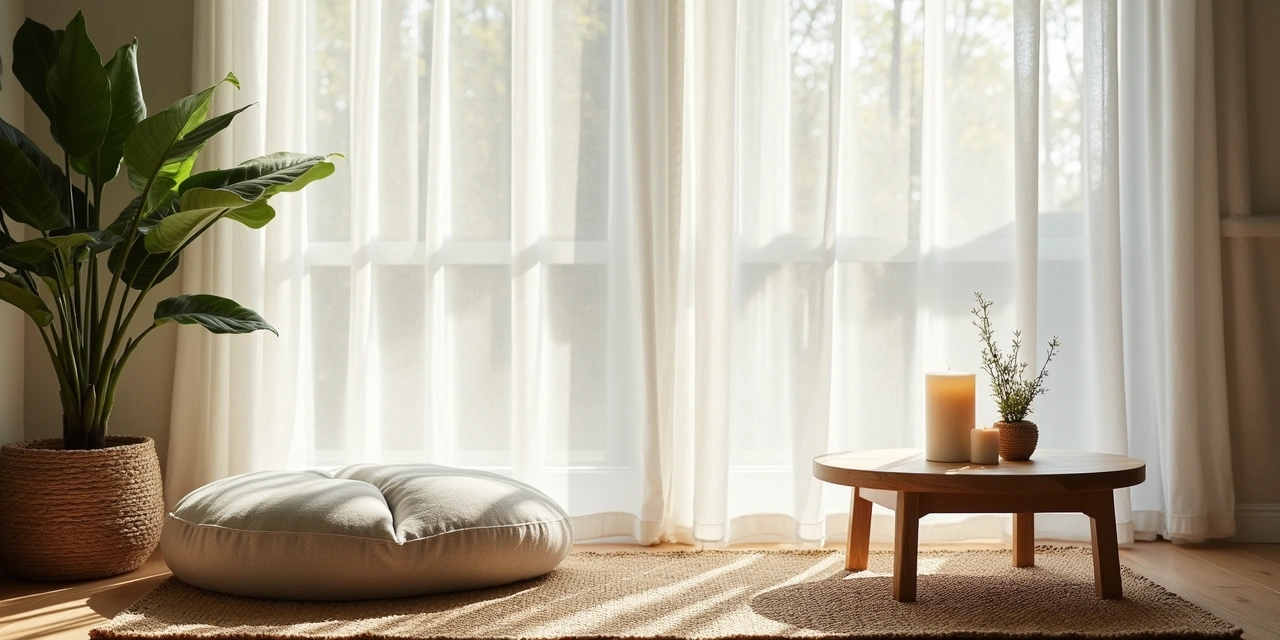
The Psychology of Place
Environments cue behavior. This is not motivational language — it is a well-documented principle of behavioral science. Specific places, through repetition, become associated with specific mental and physical states.
A desk triggers work mode. A bedroom triggers sleep. A kitchen triggers hunger.
James Clear's Atomic Habits calls environment design the most underused lever in habit formation. Most people rely on willpower instead, and willpower depletes. Environment design does not — the environment does the triggering.
A wellness space works the same way. Give it two to three weeks of consistent use. After that, sitting in that spot triggers the parasympathetic state on its own.
This happens before you've taken a single breath. The location itself becomes the cue. Keep it consistent — moving it resets the association.
Choosing the Space
You are not choosing a room. You are choosing a spot. It should be quiet enough that you can hear yourself breathe.
It needs room for a yoga mat, about 6 by 2 feet, plus natural light.
In a Westchester colonial or cape, a few spots tend to work well. One is the farthest corner of the primary bedroom, away from the door and TV.
A home-office corner works too, away from your actual desk. So does a living-room window alcove, or a basement corner lit by an egress window.
The guest bedroom is a common choice that frequently fails. It works when the door closes and the space isn't dual-purposed. It fails when the room turns into equipment storage and the mat gets buried.
Selection Principle
Choose the spot you will actually use, not the one that photographs best. Proximity to your morning routine beats a distant, more attractive location every time.
The Minimum Viable Setup
Three items, total. A yoga mat, whose non-slip surface marks the space as practice-only, physically. A cushion, zafu, or folded firm blanket, to elevate the hips in seated practice.
A lightweight blanket for warmth during still practices, like Yoga Nidra, when body temperature drops.
That is the complete functional setup. Every additional item is optional.
The mat defines the space. The cushion makes sitting sustainable, and the blanket makes stillness comfortable. Nothing else is structurally necessary.
One practical rule: the mat never gets rolled up and stored. It lives on the floor, cushion on top, blanket folded beside it. The moment you have to assemble the setup before practicing, the friction of beginning increases.
That friction is the difference between a habit and an intention.
Enhancing the Environment: What Research Supports
Light: Natural light is the strongest environmental variable with research support. Kaplan calls it "soft fascination" — gentle stimulation like light through leaves.
Position your spot to receive morning light if possible. A simple full-spectrum bulb works too — 5000K, or 2700K for evening practice.
Scent: Lavender has genuine evidence behind it. Moss and colleagues (2010) found significant drops in anxiety and improved mood with lavender inhalation.
A diffuser with lavender oil during practice builds a scent-practice association over time. Eventually, the smell alone triggers relaxation. Frankincense and sandalwood have traditional use, with modest supporting research.
Sound: Silence, birdsong or rain, or low-volume instrumental music without lyrics all work. White noise reduces the impact of household intrusions. Binaural beats in the theta range, 4–8 Hz, have modest evidence for deepening meditative states.
That's the same mechanism used in sound baths.
Avoid music with lyrics during meditation. Language processing competes with attentional focus.
Temperature: Slightly cool is better than warm for alert practices. A blanket handles seated chill without compromising the thermoregulation that supports focus.
Aesthetic theater looks like this: elaborate altars, crystals, singing bowls you can't play. Candles in non-fireproof spots. Expensive cushions bought before you've built a practice.
These are rewards for a practice, not prerequisites for one.
The most effective home sanctuaries are anchored by a repeatable daily protocol. The Breathing Protocol is designed for exactly this use.
View the Protocol →The Sanctuary in a Suburban Home with Kids and Partners
Protecting a home practice space in a family environment takes two things. Explicit communication, and a reliable time window. The space itself cannot prevent interruption — only agreement about the space can.
Tell your household directly: "This is where I meditate. Unavailable here, unless it's an emergency."
Most school-age children understand this clearly. They respect it consistently, especially when the rule stays stable.
The most reliable window in a Westchester home is early morning, before the household wakes. The 5:45 to 6:30am slot, before the 7am school rush, is usually undisturbed.
If early morning is impossible, try right after school drop-off, 8:30 to 9am. For a WFH parent, that's the second most protected slot.
Partners can use the same space, sequentially rather than simultaneously. That reinforces the practice association for both. Respect is what makes it work.
Technology in the Sanctuary: What Helps vs. What Disrupts
A phone in the sanctuary, face-up and notifications on, is a practice-ender. The brain cannot sustain present-moment awareness when it is also monitoring for interruption. The phone goes face-down, on Do Not Disturb, outside the room if possible.
This is non-negotiable.
Some technology genuinely helps. A Bluetooth speaker works well for guided meditations; set the track before you sit down. That way the phone never comes out mid-practice.
A timer on a smartwatch skips the phone check entirely. A smart bulb, dimmed and set before the session begins, helps too.
Dedicated meditation apps — Insight Timer, Waking Up, Ten Percent Happier — are legitimate tools. Use them on a tablet or dedicated device if you can. That separates them from the phone carrying your work notifications.
The app is a teacher. The phone is an anxiety delivery system.
A Day in the Sanctuary
6:10am. The mat is already out. You sit on the cushion before the rest of the household wakes.
Five minutes of box breathing. Ten minutes of seated mindfulness — following the breath, returning when the mind wanders. Three written intentions for the day.
The whole sequence takes 18 minutes. It happens because the mat is already out. The cushion is already in place.
The diffuser has lavender from yesterday and needs only to be switched on. The barrier to beginning is close to zero. See the full holistic morning routine guide for the complete protocol that this space supports.
Maintaining It: Why Most People Abandon Home Spaces
Home practice spaces fail for one of three reasons. The setup gets dismantled — guests, cleaning, "temporarily" storing something on the mat.
The time slot gets colonized by other activities. Or the practice goal gets too ambitious, too fast.
The mat rule handles the first problem. A weekly calendar block — treated as non-negotiably as a meeting — handles the second. The third requires deliberate minimum viable practice: when life compresses, do five minutes, not zero.
Five minutes on the cushion maintains the habit association even when depth is unavailable.
Clear's research on habit durability puts the critical threshold at 66 days. That's the median time for a behavior to become automatic.
The first 66 days require active protection. After that, the practice largely sustains itself.
Want a daily habit? Check out our daily meditation habit guide for a full walkthrough. For sound, our sound bath guide covers what instruments to bring home.
Home Sanctuary Setup Checklist
Essential — Week 1
Corner, alcove, or area near natural light — not a room, a spot. Mark it mentally and claim it with your household.
A 6mm PVC or natural rubber mat defines the practice boundary. It never gets rolled up.
Hip elevation makes seated meditation sustainable past 5 minutes. A zafu is ideal, but a firm folded blanket works immediately too.
Body temperature drops during still practice. A lightweight blanket folded beside the cushion eliminates this barrier before it arises.
Put it on the calendar. Early morning before household activity is the most reliable window in a suburban family home.
Enhanced — Month 1
The scent-practice association deepens over time. Switch it on as you sit — the cue becomes automatic within weeks.
A dedicated small speaker for rain, singing bowls, or guided meditations. The separation from your phone is the point.
Kaplan's research identifies natural elements as significant contributors to attention restoration. A pothos or ZZ plant works well.
Optional — Aspirational
A struck bowl signals that the practice period has begun, a powerful behavioral anchor. Not required, but valuable once the habit is established.
Set to a dim, warm scene for evening practice. Controls blue light exposure and signals wind-down to the nervous system.
Gentle pressure on the eyelids activates the oculocardiac reflex, mildly slowing heart rate. A lavender-filled eye pillow combines this with scent.
Last updated April 2026. Not medical advice. Consult a qualified practitioner before beginning any wellness program.
Sources
- Clear J. (2018). Atomic Habits: An Easy & Proven Way to Build Good Habits & Break Bad Ones. Avery. (Environment design, habit stacking, 66-day threshold.)
- Kaplan S. (1995). The restorative benefits of nature: Toward an integrative framework. Journal of Environmental Psychology, 15(3), 169–182. (Attention Restoration Theory.)
- Moss M, Cook J, Wesnes K, Duckett P. (2003). Aromas of rosemary and lavender essential oils differentially affect cognition and mood in healthy adults. International Journal of Neuroscience, 113(1), 15–38.
Frequently Asked Questions
No. Research on habit formation shows a consistent spot is enough — even a small corner. A whole room is aspirational; a claimed corner is functional.
The practice matters, not the square footage.
Three items: a yoga mat, a cushion or folded blanket, and a blanket for warmth. Everything else — candles, plants, singing bowls, app speakers — is enhancement. Start with the essentials, and add only what supports the practice, not what performs it.
Two strategies work best. The first is time-based protection: early morning, school hours, or after bedtime. The second is explicit communication with family members about the space and its purpose.
A closed door or a simple signal, like a lit candle, establishes a boundary. Most households learn to respect it within weeks.
Lavender has the strongest evidence base for relaxation. Studies show measurable drops in anxiety and cortisol.
Frankincense and sandalwood have traditional use and modest research support. Peppermint activates rather than calms.
Skip it. Skip synthetic sprays too, and use a diffuser instead.
The single most reliable predictor is environmental consistency. The space stays set up and ready, rather than assembled and disassembled each time. Never put the mat away, and keep the cushion on it.
Make the barrier to starting as close to zero as possible. When motivation fails, environment carries the practice.
Editorial Integrity
WestChester Zen editorial content is research-based and independently produced. No sponsored studio listings. Full policy at disclosures.