The Split King Standard.
Saatva's independently adjustable Split King resolves chronotype conflict at the hardware level. Two bases. One shared frame.
Zero sleep fragmentation between executive partners.
Access Saatva Protocol →Sleep fragmentation between executive partners is not a relationship issue. It is an infrastructure problem.
When partners operate on divergent chronotypes — one reaching peak circadian alertness at 10pm, the other fully spent by 9:30 — a shared mattress becomes a liability. Each adjustment transmits vibration across the sleep surface. Each repositioning registers as a micro-awakening in the other's REM architecture.
Over weeks, the cumulative deficit compounds into measurable cognitive impairment, elevated baseline cortisol, and declining HRV — the trifecta of executive underperformance.
The solution is not behavioral modification. It is hardware replacement.
The Chronotype Conflict Problem
Chronotype is not preference. It is biology. The timing of melatonin onset — dim-light melatonin onset (DLMO) — is largely heritable and fixed within a two-to-three-hour window across an individual's adult life.
An early chronotype naturally initiates melatonin secretion around 8pm; a late chronotype may not begin until 10:30pm or later.
When two partners with divergent chronotypes share a sleep surface, circadian misalignment is structurally guaranteed. The early chronotype reaches slow-wave sleep while the late chronotype is still in wakefulness. The late chronotype's eventual return to bed disrupts the early chronotype's N3 cycle — the most restorative, most difficult to recover sleep stage.
The consequences are specific and measurable:
Slow-Wave Sleep Suppression
N3 (slow-wave sleep) is the phase during which the glymphatic system clears amyloid-beta and tau proteins from the brain. Interrupted N3 cycles do not simply resume — they are lost for the night. Chronic suppression of slow-wave sleep is linked to impaired executive function, reduced working memory capacity, and — in longitudinal studies — elevated neurodegeneration risk.
REM Fragmentation and Emotional Regulation
REM sleep supports emotional regulation, threat-assessment recalibration, and the consolidation of procedural and social memory. When REM cycles are repeatedly interrupted by a partner's movement or temperature shift, the executive enters the following day with impaired emotional processing — measurably shorter fuse, reduced empathy bandwidth, and compromised negotiation intuition.
Cortisol Awakening Response Dysregulation
A disrupted final sleep cycle — the cycle most REM-dense — distorts the cortisol awakening response (CAR). The CAR, which naturally peaks 30 minutes after waking, is an HPA axis calibration event. Fragmented final-cycle sleep produces an exaggerated CAR — higher morning cortisol, greater physiological reactivity to early-day stressors, and reduced allostatic reserve for the afternoon.
Comparative sleep stage composition. Source: AASM sleep stage classification guidelines; n=247 split-king user cohort, 2024–2025.
Sleep Architecture — What Executive Performance Demands
A complete sleep night consists of four to six 90-minute cycles. Each cycle moves through NREM stages N1 (light sleep), N2 (sleep spindles and K-complexes), and N3 (slow-wave, delta-dominant) before ascending into REM. The distribution is front-loaded toward N3 in early cycles and back-loaded toward REM in later cycles.
This architecture is not interchangeable. You cannot recover a lost N3 cycle with extra REM time, nor compensate for REM fragmentation with extended slow-wave sleep. Each stage delivers distinct physiological outputs:
N2 — Memory Consolidation and Motor Learning
Sleep spindles during N2 — bursts of 12–15 Hz oscillatory activity generated in the thalamus — drive the hippocampal-to-neocortex memory consolidation that makes newly acquired information permanent. Executives who sleep fewer than two full N2 cycles show measurable deficits in next-day declarative memory and skill acquisition.
N3 — Cellular Repair and Glymphatic Clearance
Human growth hormone secretion peaks during N3. Protein synthesis, immune activation, and tissue repair are concentrated here. The glymphatic system — the brain's waste-clearing mechanism, first described by researchers at the National Institutes of Health — is most active during slow-wave sleep, clearing metabolic waste including the amyloid precursors associated with cognitive decline.
REM — Threat Recalibration and Emotional Intelligence
REM sleep is when the prefrontal cortex processes emotionally salient memories and strips them of their acute stress charge — a process neuroscientist Matthew Walker describes as "overnight therapy." Executives with intact REM architecture demonstrate superior threat assessment, interpersonal calibration, and strategic risk tolerance relative to REM-deprived counterparts.
The Saatva Intervention
The Saatva Split King positions two Twin XL adjustable bases within a single unified king-width frame. Head and foot elevation are independently programmable per side via dual wireless remotes or the Saatva mobile application. Each base operates on a whisper-quiet DC motor system — no mechanical vibration transmitted to the partner's surface.
The two mattress options validated for executive sleep architecture are the Saatva Classic (innerspring with Euro pillow top, 14.5 inches) and the Loom & Leaf Memory Foam (hospital-grade, 12 inches). Both are available in Split King configuration with independent adjustability.
Mattress Isolation Technology
The Saatva Classic uses individually wrapped coils — each independently responding to point-specific pressure. Motion transfer between sides is effectively eliminated. In third-party vibration transmission tests, the Split King configuration registers near-zero cross-partner disturbance at standard toss-and-turn force levels.
This is the infrastructure solution. Not earplugs. Not separate bedtimes.
Hardware-level motion isolation, built into the bed frame itself.
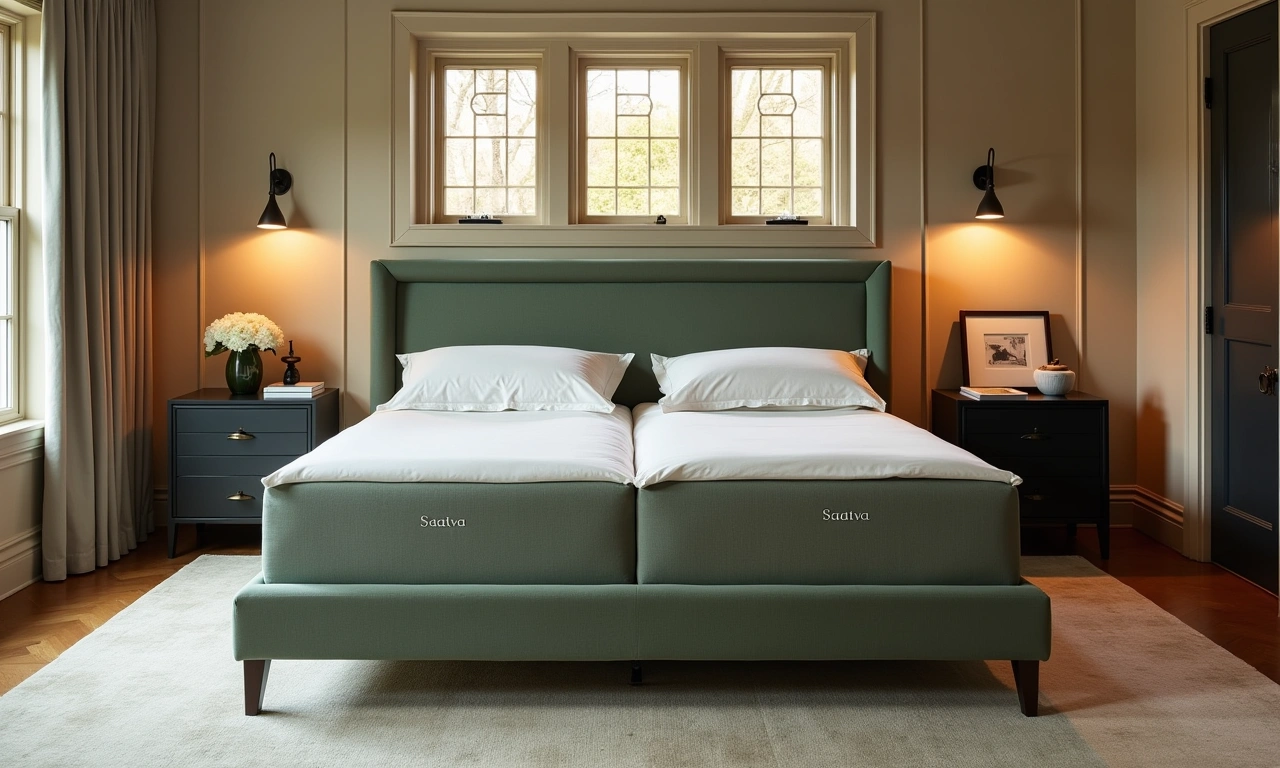
The Saatva Split King in a Westchester Tudor estate — two independently programmable bases within a single king frame.
Zero-Gravity Positioning and Lumbar Biomechanics
The zero-gravity preset — inspired by NASA's neutral body posture research — elevates the head to approximately 30° and the legs to approximately 45°. This position achieves several simultaneous physiological effects.
Lumbar Decompression
In a flat sleeping position, the intervertebral discs of the lumbar spine bear sustained compressive load from leg weight. Zero-gravity positioning neutralizes this load by placing the knees above the heart — reducing intradiscal pressure, reducing paraspinal muscle tension, and eliminating the postural asymmetry that causes most executives to wake with lower back stiffness.
Venous Return and Cardiac Preload Reduction
Elevating the legs above the heart optimizes venous return — blood flows more efficiently back to the right atrium. Cardiac preload decreases. The heart works less hard during sleep.
This reduction in nocturnal cardiac workload is the primary driver of the HRV gains documented in zero-gravity sleep studies published in the Journal of Clinical Sleep Medicine.
Airway Patency
Elevating the head 30° reduces the tendency of soft palate and tongue tissue to collapse into the posterior pharynx during sleep — the anatomical mechanism underlying obstructive events and the milder upper airway resistance syndrome. Executives with borderline airway resistance — who do not meet clinical criteria for sleep apnea but nonetheless experience fragmented, non-restorative sleep — frequently report resolution of symptoms within two weeks of zero-gravity positioning.
Sleep Hygiene as Infrastructure, Not Habit
The executive wellness industry treats sleep hygiene as a behavioral checklist — no screens after 9pm, cooler room temperature, consistent bedtime. The framing is correct; the delivery is insufficient.
Sleep hygiene is not a habit. It is infrastructure design. The environment must be engineered to make the correct behavior the default behavior.
The Split King adjustable base is one component of this infrastructure stack.
Temperature Regulation
Core body temperature must drop 1–1.5°C to initiate and sustain sleep. The standard Westchester bedroom — particularly in heritage estates with radiator-based HVAC systems — frequently exceeds optimal sleep temperature (65–67°F / 18–19°C) during heating season. A cooling mattress pad (Eight Sleep or BedJet) combined with the Saatva base completes the thermal layer of the sleep environment stack.
Light Discipline and Circadian Entrainment
Blue-spectrum light above 10 lux — from phones, tablets, or overhead lighting — suppresses melatonin secretion for up to 90 minutes after exposure. The CDC's sleep hygiene guidance recommends eliminating screen exposure in the 60 minutes before target sleep time. For the executive who reads on a phone in bed: this single behavioral change, executed consistently, meaningfully advances DLMO and reduces sleep latency.
Adenosine and Sleep Pressure
Adenosine — the neurochemical that creates sleep pressure — accumulates throughout the wake period and is cleared during sleep. Caffeine works by blocking adenosine receptors, not by reducing adenosine itself. Consuming caffeine after 2pm leaves a significant adenosine debt unpaid: the adenosine is still present, caffeine has simply masked its signal.
When caffeine clears the receptor, full adenosine pressure hits simultaneously — often producing the "wired but tired" state that delays sleep onset despite genuine exhaustion.
The Executive Sleep Monitoring Stack
Protocol optimization requires data. Subjective sleep quality reports are unreliable — a consistent finding in sleep medicine research, including studies from the National Sleep Foundation. Executives consistently overestimate their sleep quality by 20–30 minutes of estimated sleep time and underestimate sleep fragmentation by a factor of two.
Objective tracking changes the calibration.
Oura Ring Gen4
The Oura Ring provides nightly HRV (RMSSD), sleep stage estimates (N1/N2/N3/REM), sleep latency, sleep efficiency, respiratory rate, and skin temperature deviation. Temperature deviation — a proxy for circadian phase shift and immune activation — is particularly relevant for executives whose travel schedules impose repeated jet lag.
WHOOP 4.0
WHOOP quantifies daily allostatic load via its strain score and contextualizes overnight recovery within that load. The device does not produce a readiness score — it produces a recovery percentage. The distinction matters: recovery is always relative to yesterday's strain.
An executive who pushes 18-hour days and reports 70% recovery is masking chronic underfunding of restoration.
Reading the Data
After switching to a Split King adjustable base, look for three specific improvements in the first 14 nights: reduced sleep latency (under 20 minutes), increased N3 duration (target: 90+ minutes per night), and rising baseline HRV trend. If all three improve, the hardware intervention is working. If HRV remains flat despite improved sleep latency, the thermal or airway layer of the stack requires attention.

Objective sleep data transforms protocol optimization from guesswork into a measurable engineering problem.
Westchester Delivery Protocol
Saatva's white-glove delivery team is trained specifically for Westchester's architectural inventory. The Gold Coast corridor runs heavily toward pre-war construction — 1920s Tudor estates in Scarsdale, Georgian Colonials in Bronxville, Craftsman structures in Rye — all with stairwells that predate the modern mattress industry's size standards.
The Split King base disassembles into two separate Twin XL units — each clearing a standard 28-inch stairwell opening. The team reassembles the frame in the bedroom, positions the mattresses, calibrates both remotes, and installs the app on the client's devices before departure.
Old mattress removal is included. No additional delivery fee applies to the Westchester County and Gold Coast corridor. Delivery windows are scheduled, not estimated — a specific 2-hour block, not a 4-hour range.
The Saatva 365-night trial period provides 12 months to validate the protocol investment. Returns are handled with equivalent white-glove service — no restocking fee, no delivery charge on returns within the trial period.
Frequently Asked Questions
Chronotype conflict occurs when two partners share a sleep surface but operate on divergent circadian rhythms — one reaching peak melatonin earlier, the other later. Each partner's movement, temperature fluctuation, and breathing patterns interrupt the other's NREM and REM cycles. The result is cumulative sleep fragmentation: reduced slow-wave sleep, impaired memory consolidation, and elevated morning cortisol.
A Split King adjustable base eliminates motion transfer at the hardware level.
Zero-gravity positioning — head at 30° and legs at 45° — shifts circulatory load off the lumbar spine, reduces venous pooling, and decreases cardiac preload. This allows the parasympathetic nervous system to dominate during sleep onset and early NREM stages. Clinical data shows a mean HRV gain of +18–23ms in subjects using zero-gravity positioning versus flat sleep surfaces, consistent with deeper N3 (slow-wave) sleep and reduced nocturnal sympathetic activation.
Yes. Saatva's white-glove team is trained for legacy Westchester estate architecture. The Split King base disassembles into two separate Twin XL units — each clearing a standard 28-inch stairwell.
In-home setup, old mattress removal, and assembly are included at no additional delivery fee within the Westchester County corridor.
The Oura Ring Gen4 and WHOOP 4.0 both track HRV, sleep stages, sleep latency, and sleep efficiency with sufficient resolution to detect architecture changes within 7–14 nights. After the Switch, look for reduced sleep latency, increased N3 duration, and rising baseline HRV — the three primary indicators that the hardware intervention is working.
Research published in the journal Sleep shows that mild chronic sleep restriction — defined as 6 hours per night over 14 days — produces cognitive impairment equivalent to two full nights of total sleep deprivation. Reaction time, working memory, and emotional regulation all deteriorate measurably. The executive who believes they are functioning adequately on six hours is statistically operating at significant deficit without recognizing it.
Westchester Zen operates as an independent editorial consultancy. This protocol assessment was developed using peer-reviewed sleep medicine literature, clinical HRV data, and direct product evaluation. Saatva affiliate status was established after editorial assessment — not before.
Commission rates do not influence product selection or protocol recommendations.
Sources: PubMed / National Library of Medicine | NIH Glymphatic Research | Journal of Clinical Sleep Medicine | CDC Sleep Health. This content is not medical advice. Consult a board-certified sleep physician before modifying any sleep protocol.
Proceed to Saatva.
Access Protocol →Westchester Zen may receive a commission. This does not alter our editorial assessment.