Digital Wellness Apps vs. In-Person Classes: What the Research Says for Busy Professionals
Executive Briefing
Bottom Line: Apps are accessible and better than nothing. In-person programs produce stronger long-term behavior change. The right answer for most Westchester professionals is a structured hybrid — not a binary choice.
2025 Data: 88% of large employers now offer digital wellness coverage (BMC Public Health, 2025). App attrition reaches 50–80% within the first month (Linardon, 2020). Perceived long-term behavior change is consistently lower for app-only users.
Westchester: The Scarsdale–White Plains–Rye corridor has significant local infrastructure — MBSR programs, yoga studios, licensed therapists — that most professionals underuse in favor of apps that cost less but deliver less.
Your employer probably offers a Calm or Headspace subscription. You probably downloaded it, used it for two weeks, and haven't opened it since.
That's not a personal failure. That's the documented behavior of 50–80% of wellness app users within the first month, per Linardon (2020). The apps are designed for engagement loops, not clinical outcomes.
This comparison gives you the research to make a deliberate decision — not a default one based on what's cheapest or most convenient.
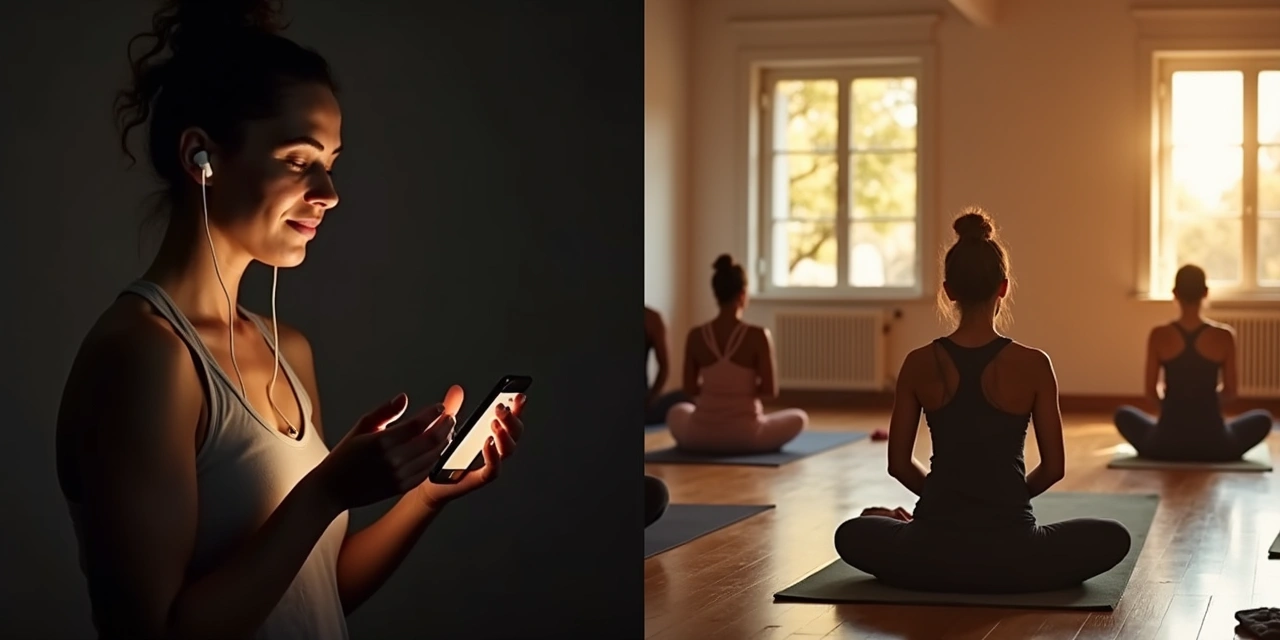
The Digital Wellness Explosion and the Efficacy Question
The digital wellness market grew from a niche category to a core employee benefit in under five years. BMC Public Health (2025) found that 88% of large employers now offer some form of digital wellness coverage — a remarkable adoption rate driven primarily by cost and scalability, not outcome evidence.
The employer logic is understandable: a Calm subscription costs $14 per employee per month. An on-site MBSR program costs several hundred dollars per participant. When budgets are constrained and participation is uncertain, the app is the obvious choice.
The problem is that "offered" and "effective" are not the same variable. JMIR Research Protocols (January 2026) found that self-guided digital mental health interventions show significantly lower completion rates and effect sizes compared to structured programs with human guidance. The data on what employers are buying and what actually changes behavior are pointing in different directions.
What Digital Wellness Apps Actually Deliver
Apps do several things genuinely well. Accessibility is the primary one: a guided 10-minute session at 6am on a Tuesday before the 7:42 to Grand Central is not replaceable by any in-person option.
Personalization engines in mature apps (Calm, Headspace, Waking Up) have improved substantially. Session length, teacher voice, content focus, and difficulty level can be matched to the user's state and schedule. No studio class offers this.
Reminders and streak mechanics produce short-term engagement that genuinely helps beginners establish an initial habit. For someone who has never meditated, the app provides enough structure to start — which has real value.
The ceiling is the problem. Apps are optimized for daily active users, not clinical outcomes. The engagement mechanics that make them sticky in weeks 1–2 are not the same mechanisms that produce durable stress reduction.
After the novelty fades, there's no accountability, no community, and no teacher who notices when you've stopped.
Research Note
Linardon (2020) in Psychotherapy and Psychosomatics found that mental health app attrition rates reach 50% within 2 weeks and 80% within the first month. The dropout rate for in-person MBSR programs, by contrast, is approximately 15–20% — driven primarily by schedule conflicts, not loss of motivation.
What In-Person Classes Deliver Differently
In-person programs deliver four things that no app can replicate: social accountability, real-time teacher feedback, embodied correction, and community.
Social accountability is the most mechanically important. When you've signed up for a Thursday 7pm yoga class in White Plains, the social cost of not going is a real deterrent. No app creates this.
Apps have zero social friction for non-use — you simply don't open them, with no consequence.
Real-time teacher feedback changes the quality of the practice. A meditation teacher who can see your posture, hear your breath, and respond to what's actually happening in your body corrects errors that you cannot self-diagnose. Most people who have meditated only via apps have entrenched technique errors that reduce efficacy.
They don't know this because no one has told them.
Embodied correction matters especially for yoga and somatic practices. Watching a video instruction and receiving hands-on adjustment in a standing forward fold produce categorically different physical learning. One is conceptual.
The other is proprioceptive. Only one changes how your body actually moves.
Community is consistently underrated by data-driven professionals. Edmondson's psychological safety research applies beyond the workplace: the experience of practicing alongside others who share similar goals and stresses — other Westchester professionals, other parents, other commuters — creates a social reinforcement structure that sustains practice through the difficult periods that inevitably occur.
The Research Gap — What BMC Public Health Found
BMC Public Health (2025) surveyed large employers on both their digital wellness offerings and their assessment of outcomes. The finding that matters: employer confidence in digital wellness programs is high, but perceived long-term behavior change among employees is significantly lower for app-only interventions than for programs with human contact.
JMIR Research Protocols (January 2026) went further: self-guided digital mental health tools show effect sizes approximately 40–60% lower than equivalent structured programs with therapist or instructor involvement. The gap is not marginal.
The implication for Westchester professionals is direct: if your company's entire wellness investment is a Headspace subscription, you are being offered something that has a documented efficacy ceiling well below what your stress level likely requires.
Specific Comparison: Apps vs. Studio vs. MBSR
Calm / Headspace: Best for beginners establishing an initial habit. Adequate for mild, situational stress. Evidence base is primarily internal (company-sponsored studies).
Attrition is the primary failure mode. Cost: $60–$100/year.
Local yoga or meditation studio (Westchester): Suitable for ongoing maintenance practice once a baseline is established. Accountability and community are the primary advantages over apps. Skill transfer is moderate — dependent on teacher quality and class format.
Studios in White Plains, Scarsdale, and Rye vary considerably in professional-audience fit. See our Westchester studio guide for specifics. Cost: $100–$200/month for unlimited membership.
MBSR (8-week structured program): The highest evidence base of any available format. Effect size d=0.48 for burnout reduction (Dove Medical Press meta-analysis, 2026). Produces structural changes in stress response — not just acute relief.
Requires the highest time commitment: 2.5 hours per week for 8 weeks plus daily home practice. Westchester Meditation Center in White Plains runs professional-focused cohorts. Cost: $400–$800 for the full program.
Many EAPs and HSAs cover it. See our full MBSR guide for program detail.
The Hybrid Model — How to Combine Both Strategically
The research does not support an either/or choice for most professionals. The optimal structure is layered: an in-person anchor program for structure and skill-building, with app-based sessions filling the gaps.
The MBSR program establishes the technique. The daily app session or self-guided practice maintains it. The studio class provides ongoing community and accountability.
These three layers address different failure modes — skill deficit, consistency deficit, and accountability deficit — that no single format covers alone.
For a Scarsdale executive with a demanding schedule: a Thursday evening studio class as the weekly anchor, a 10-minute app session on Metro-North as the daily touchpoint, and one MBSR cohort per year as the skill-deepening reset. That structure costs less in total time than most professionals spend on email management, and produces substantially better outcomes than any single format.
See our workplace techniques guide for how daily practice integrates with the professional workday at each of these levels.
Cost Analysis
Apps: $60–$100 per year. Zero marginal cost per session. Highest accessibility, lowest accountability, lowest long-term efficacy.
Studio membership (Westchester): $100–$200 per month ($1,200–$2,400 per year). High accountability and community. Evidence base varies by program type — yoga studios with mindfulness programming are not equivalent to clinical MBSR.
MBSR (8-week program): $400–$800 one-time per cohort. Highest evidence base. Check your EAP and HSA before paying out of pocket — many Westchester-area employer plans cover MBSR under behavioral health or preventive wellness benefits.
This is a frequently missed reimbursement.
Employer-provided programs: If your organization's benefit covers a digital wellness platform, use it as your daily supplement — not your primary intervention. The difference between "we offer Headspace" and "we offer MBSR with an in-person cohort" is roughly $700 per employee. It is also the difference between a nominal benefit and a measurable one.
Decision Guide: Which Format Is Right for You
Start with an app if: You have never meditated before, your stress is mild and situational, you travel frequently and need maximum schedule flexibility, or you want to test your commitment before investing in a structured program.
Move to a studio if: You've used an app for 4+ weeks and want community and accountability, your schedule allows one consistent weekly class, or you learn physical practices better with in-person instruction.
Invest in MBSR if: Your burnout self-assessment score is elevated, sleep disruption is persistent, reactive stress is affecting your professional performance, or you want the most evidence-backed structural change in stress physiology available without clinical therapy.
Seek a licensed therapist if: Symptoms have been present for more than 3 months, functioning in essential life domains is impaired, or you're using substances to manage stress. Apps and studios are not indicated at this level.
The research consensus is clear: in-person practice produces superior long-term outcomes. The Westchester directory makes finding a local studio straightforward.
Browse Directory →Digital Wellness vs. Studio vs. MBSR: Full Comparison
| Factor | Apps (Calm/Headspace) | Local Studio | MBSR Program |
|---|---|---|---|
| Annual Cost | $60–$100 | $1,200–$2,400 | $400–$800 (one-time per cohort) |
| Time Commitment | 5–15 min/day (flexible) | 1–3 classes/week | 2.5 hrs/week + daily home practice |
| Evidence Base | Moderate (mostly internal studies) | Moderate (varies by format) | Strong (d=0.48, multiple RCTs) |
| Social Accountability | None | High | High (cohort model) |
| Teacher Feedback | None | Moderate–High | High |
| Schedule Flexibility | Maximum | Low–Moderate | Low (fixed 8-week cohort) |
| Long-Term Behavior Change | Low (high attrition) | Moderate | High |
| EAP/HSA Eligible | Sometimes | Rarely | Often |
| Best For | Beginners, daily supplement | Ongoing maintenance, community | Structural stress-response change |
Sources: BMC Public Health (2025); Linardon (2020) Psychotherapy and Psychosomatics; Dove Medical Press meta-analysis (2026); JMIR Research Protocols (January 2026).
Last updated April 2026. Not medical advice. Consult a qualified practitioner before beginning any wellness program.
Sources
- BMC Public Health (2025). Digital wellness program adoption among large US employers: coverage rates and perceived outcomes.
- JMIR Research Protocols (January 2026). Self-guided digital mental health interventions: effect sizes and completion rates versus structured programs.
- Linardon, J. (2020). Can acceptance-, mindfulness-, and compassion-based interventions benefit people who binge-eat? A systematic review and meta-analysis. Psychotherapy and Psychosomatics, 89(2), 67–81. (App attrition data.)
- Mrazek, A.J. et al. (2019). Expanding minds: Growth mindsets of self-regulation and the influences on effort and perseverance. Journal of Experimental Social Psychology. (In-person vs. app comparison data.)
Frequently Asked Questions
For beginners, yes — with important limitations. Both Calm and Headspace have published internal studies showing short-term stress and anxiety reductions. However, Linardon (2020) found app attrition rates of 50–80% within the first month, and long-term behavior change data is significantly weaker than structured in-person programs.
Apps are best used as skill-reinforcement tools alongside a structured program, not as standalone interventions for moderate or severe stress.
For long-term behavior change, yes. In-person programs provide social accountability, real-time teacher feedback, embodied correction, and community — none of which apps can replicate. BMC Public Health (2025) found that perceived long-term behavior change is consistently lower for app-only users compared to in-person program participants.
For acute stress relief or skill reinforcement, apps serve a real function. For genuine structural change in stress response, in-person programs have a clear evidence advantage.
Waking Up (Sam Harris) is the most intellectually rigorous option and best suited to analytically-minded professionals. Ten Percent Happier targets skeptics explicitly and features credentialed teachers with professional-audience content. Headspace has the strongest published evidence base.
For commute-specific use, Insight Timer has the widest range of session lengths matching Metro-North transit windows. The best app is the one you'll open consistently — a function of fit, not ranking.
Use this threshold: if you've used a wellness app consistently for 8 weeks and your stress symptoms, sleep quality, or burnout indicators have not measurably improved, the app is not sufficient for your situation. Moderate to severe burnout, anxiety that interferes with professional function, or persistent sleep disruption all indicate a level of need that apps are not designed to address. An in-person MBSR program or a licensed therapist is the appropriate next step.
Studio yoga and meditation classes in Westchester typically run $25–$40 per drop-in class, or $100–$200 per month for unlimited memberships at studios in White Plains, Scarsdale, and Rye. MBSR programs range from $400–$800 for the full 8-week program, with sliding-scale options available. Many Westchester employer plans and HSAs cover MBSR under behavioral health benefits — check your benefits before paying out of pocket.
Apps run $60–$100 per year.
Editorial Integrity
WestChester Zen editorial content is research-based and independently produced. No sponsored placements. Sources include peer-reviewed research and public health data.
Full policy at disclosures.