The 5-Minute Desk Meditation That Actually Works for High-Stress Careers
Executive Briefing
Bottom Line: Five minutes between meetings, at your desk, with no equipment, measurably shifts your cortisol trajectory before your next interaction.
Research: Vagal activation through paced breathing produces autonomic changes within 60–90 seconds (Kok et al., 2013, Psychological Science). Brief, repeated attention training changes neural architecture over weeks (Tang et al., 2015, Nature Reviews Neuroscience).
Westchester: For the executive on the 7:42 from Scarsdale, this is what fits in the calendar gap — device-free, chair-friendly, no app required.
The weekend retreat is a luxury. The 60-minute morning sit requires margin most Westchester executives don't have on a Tuesday.
Five minutes at your desk is what you actually have. And five minutes, done consistently, does real physiological work.
This is not a consolation prize for people who can't do "real" meditation. It's a precision tool for the specific stress pattern of a high-demand workday.
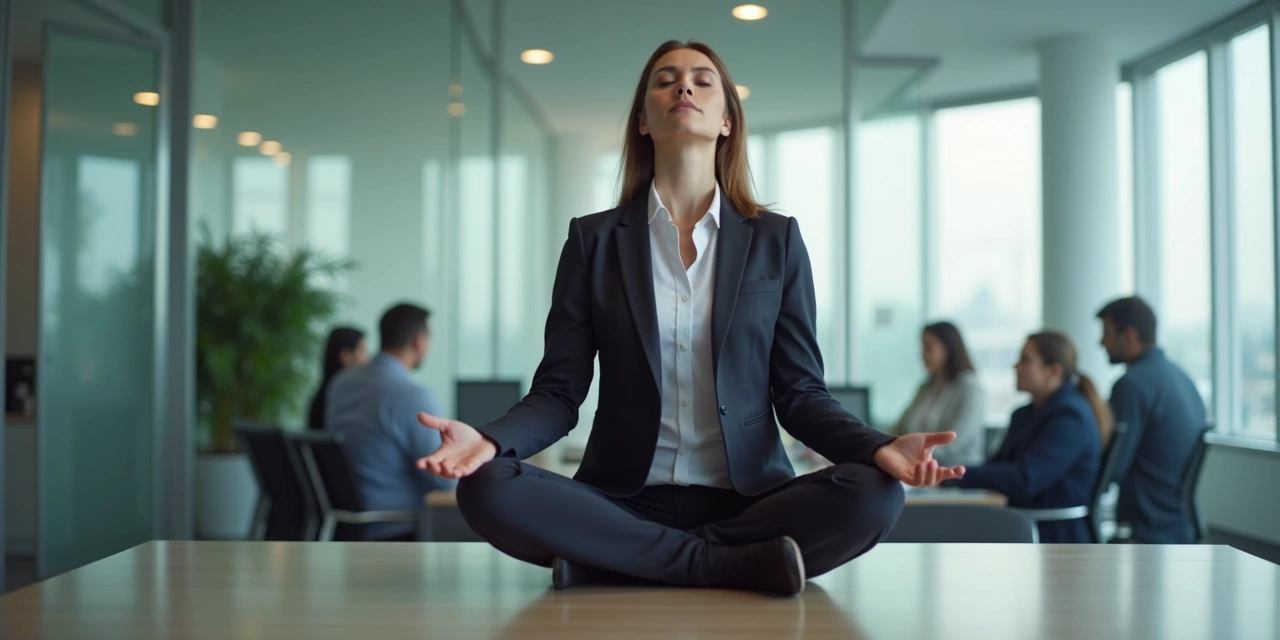
Why 5 Minutes at Your Desk Beats an Hour on Weekends
Stress is a daily accumulation problem. A once-weekly practice addresses it once a week.
The cortisol spike from a difficult 10am call is in your system at 10:06. By 10:30, without intervention, it's shaping your posture, your decision-making, and your tone in the next meeting. Weekly practice does nothing about that.
Daily brevity beats weekly depth for one specific reason: it meets stress at the point of occurrence. You are intervening on the actual events that are driving your physiological state, not trying to undo a week of accumulation on Saturday morning.
Tang et al. (2015) in Nature Reviews Neuroscience confirmed that brief, repeated attention training — as little as 5 minutes daily — produces measurable changes in white matter connectivity and Default Mode Network regulation within 2 weeks. Duration per session matters less than consistency across days.
What Makes a Desk Meditation Effective
Three elements are non-negotiable: a breath anchor, a defined interval, and a conscious return when attention wanders.
The breath anchor is what separates meditation from zoning out. You're not resting your eyes. You're actively directing attention to the physical sensation of breathing — the rise of the chest, the air at the nostrils, the brief pause at the top of the inhale.
The defined interval matters because it signals to your nervous system that this is a bounded state. "I am doing this for 5 minutes" is different from open-ended unfocused time. The boundary is part of what creates the physiological shift.
The return — noticing when attention has wandered and bringing it back without self-judgment — is the actual practice. Every return is a repetition, like a bicep curl. That's the training stimulus.
The 5-Minute Practice, Step by Step
Minute 0:00–0:30 — Setup. Both feet flat on the floor. Hands loose on your thighs.
Jaw unclenched. One deliberate exhale to mark the start.
Minute 0:30–2:00 — Box Breathing anchor. Inhale for 4 counts, hold 4, exhale 4, hold 4. Run 3–4 complete cycles.
This is the fastest route to parasympathetic activation — the vagal brake engages, heart rate drops slightly, cortisol response dampens.
Minute 2:00–4:00 — Natural breath observation. Release the count. Let the breath be normal.
Your only job is to notice it — the physical sensation, not the concept. When your mind moves to the 2pm call or the email you didn't answer, notice that, and return. No penalty.
One return is one rep.
Minute 4:00–5:00 — Body scan lite. Three-second attention to jaw. Three seconds to shoulders.
Three seconds to hands. Release obvious tension in each. This is not a full body scan — it's a fast-check of the three locations where most executives hold their workday stress.
Minute 5:00 — Return to task. One deliberate breath. Name the next task specifically — not "check email" but "respond to Henderson's proposal." Specificity breaks the diffuse mental state that causes the first post-break minutes to be unproductive.
Variations for Different Situations
Pre-meeting (2 minutes). Skip the body scan. Run 5 boxes of box breathing.
You want sympathetic activation to drop before you walk in — not full parasympathetic mode, which can blunt your edge. Two minutes of box breathing is precisely calibrated for this.
Post-difficult call (5 minutes, full protocol). After a high-conflict conversation, cortisol is elevated and your next conversation will feel it. Run the full 5-minute protocol.
The natural breath observation phase is most important here — let the nervous system complete its cycle.
Lunch break reset (10 minutes extended). Double the natural breath observation phase to 6 minutes. If you have a conference room or office, close the door.
This version produces measurable afternoon HRV improvement compared to the standard lunch break of passive screen time.
End-of-day train transition. On the platform or in the first 3 minutes on Metro-North, run the box breathing sequence eyes-open before putting in earbuds or opening your phone. See the full protocol in our commute stress guide.
What It Actually Does Physiologically
Box breathing at 4 counts per phase produces approximately 6 breath cycles per minute. This rate — called the resonance frequency — maximally stimulates the vagus nerve, producing the strongest HRV increase achievable through breathing alone.
Vagal Tone is the scientific shorthand for the strength of your parasympathetic nervous system's influence on heart rate. Kok et al. (2013) demonstrated that higher vagal tone correlates with faster physiological recovery from stress events, greater emotional regulation capacity, and more positive social interactions.
Each box breathing session is a brief vagal toning stimulus. Daily practice builds baseline vagal tone the way daily walking builds cardiovascular baseline — incrementally, measurably, over weeks.
The natural breath observation phase activates different mechanisms. It reduces Default Mode Network activity — the self-referential rumination network — and increases prefrontal cortical control over the amygdala. That's the neurological basis for the calmer decision-making you'll notice within 2–3 weeks of consistent practice.
Research Note
Thayer et al. (2009) in Neuroscience & Biobehavioral Reviews established that HRV is directly linked to prefrontal cortex function and executive cognitive performance. Higher HRV predicts better working memory, cognitive flexibility, and inhibitory control — the exact capacities that erode under chronic stress.
Handling Open Offices and Lack of Privacy
The open office is not a disqualifier. Eyes-open meditation is fully effective and indistinguishable from focused work to an observer.
Earbuds with no audio — or low-volume brown noise — signal "do not disturb" without requiring explanation. Most professionals already use this signal for deep work. You are doing deep work.
The framing is accurate.
If a colleague interrupts: "I'm in a focused block, back in 4 minutes." No meditation vocabulary required. The boundary is professional, not spiritual.
For shared desk environments or trading floors, the pre-meeting restroom technique works: 2 minutes in a private space running box breathing before a high-stakes interaction. Unglamorous. Effective.
Building It as a Habit — The Meeting-Buffer Anchor
The most reliable habit anchor for desk meditation is the meeting buffer. Block 5–7 minutes before every meeting as "prep time" in your calendar. Use 2 of those minutes for the box breathing sequence.
This works because it doesn't require a new calendar event — it reframes existing space. Every meeting you already have becomes the trigger. The meditation is embedded in the workflow, not added to it.
After 3 weeks, the pre-meeting pause becomes automatic. Attention research calls this stimulus-response chaining — the calendar reminder triggers the practice the same way a coffee smell triggers a caffeine response. You've anchored the behavior to a cue that already fires reliably.
Track your consistency for the first 14 days. Not your experience quality — just whether you did it. Frequency is the only variable that matters in the first month.
See our daily habit guide for the full 30-day architecture.
How It Differs from Wearable Protocols
A wearable measures your state. This practice changes it.
HRV tracking from an Apple Watch or Whoop tells you that your stress is elevated. The desk meditation protocol is the intervention that addresses what the wearable detected. These are complementary tools with different functions.
The wearable also introduces a layer of mediation — you're relating to a number about your body, not to your body directly. The desk practice builds direct interoceptive awareness: the ability to sense your own physiological state without a device. That's a more durable skill and more transferable to the 11pm moment when you don't have your wearable on.
See our breathwork vs. meditation comparison for further distinction.
Desk meditation is highest-impact when anchored to a morning breathwork session. The Breathing Protocol provides the complete daily framework.
View the Protocol →5 Desk Meditation Techniques to Try This Week
Last updated April 2026. Not medical advice. Consult a qualified practitioner before beginning any wellness program.
Sources
- Thayer, J.F. et al. (2009). Claude Bernard and the heart-brain connection: Further elaboration of a model of neurovisceral integration. Neuroscience & Biobehavioral Reviews, 33(2), 81–88.
- Kok, B.E. et al. (2013). How positive emotions build physical health: Perceived positive social connections account for the upward spiral between positive emotions and vagal tone. Psychological Science, 24(7), 1123–1132.
- Tang, Y.Y., Hölzel, B.K., & Posner, M.I. (2015). The neuroscience of mindfulness meditation. Nature Reviews Neuroscience, 16(4), 213–225.
Frequently Asked Questions
Yes. Effective meditation requires a stable attention anchor and a consistent practice interval — not a particular location or posture. The desk is an ideal anchor because it's where stress is highest.
Research from Tang et al. (2015) in Nature Reviews Neuroscience confirms that brief, repeated attention training in naturalistic settings produces measurable neurological changes within two weeks.
Box breathing — 4 counts in, 4 hold, 4 out, 4 hold — activates the parasympathetic nervous system within 60–90 seconds. It's the fastest evidence-based method for acute stress reduction. Three complete cycles produce a measurable drop in sympathetic activation, making it the most efficient technique for the gap between meetings.
Fix a soft gaze on a neutral point — a blank wall, a plant, or your screensaver. The eyes-open approach is standard in many formal traditions and carries no efficacy penalty. The key is reducing visual input without closing the eyes: defocus slightly, lower your gaze angle, and keep attention on breath sensation rather than what you're looking at.
Five minutes of diaphragmatic breathing with a focus anchor produces measurable autonomic changes within the session. Kok et al. (2013) showed that even brief vagal activation through slow breathing reduces the cortisol response to subsequent stressors.
The effect is both acute — shifting your next interaction — and cumulative when practiced daily over several weeks.
Box breathing is a structured pattern: inhale for 4 counts, hold for 4, exhale for 4, hold for 4. Each full cycle takes about 16 seconds at a normal count. At your desk, place both feet on the floor, relax your jaw, and run 4–5 complete boxes — roughly 90 seconds of active practice.
You can do this eyes open, earbuds in or out, before any high-stakes meeting or call.
Editorial Integrity
WestChester Zen editorial content is research-based and independently produced. No sponsored placements. Sources include peer-reviewed research and public health data.
Full policy at disclosures.